

4671 Notre-Dame Ouest,
Montreal, QC,Canada, H4C 1S7
Corner of rue Notre-Dame West
and rue de Courcelle
514-935-2226
Monday 12:00-17:00
Tuesday 10:30-17:00
Wednesday 10:30-17:00


Time moves fast. Our work is to help you hold onto the moments that matter.
Some memories fade, but with the right hands, they find their way back to life.


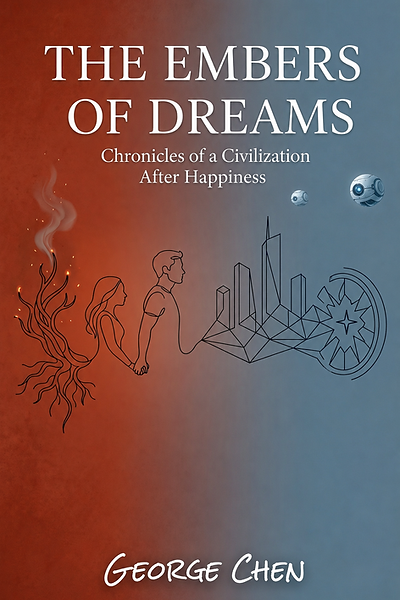
The Embers of Dreams: Chronicles of a Civilization After Happiness
In a distant future, emotions have been optimized.
Dreams are no longer private.
They are systems.
Generated.
Filtered.
Distributed.
Like infrastructure.
Like water.
Like electricity.
Like something too essential to remain uncontrolled.
Ian works inside the Dream Governance Bureau, an institution designed with a single ambition: to stabilize human experience itself.
Alongside Guliya, Mala, and others embedded within overlapping structures of care and control, he helps maintain a civilization that has nearly eliminated fear, suffering, and emotional disorder.
At least on the surface.
Because beneath this carefully balanced architecture, something begins to shift.
Dreams stop behaving.
They slip through classification systems.
They refuse categorization.
They mutate in ways that cannot be logged, predicted, or fully interpreted.
Emotional data becomes unstable.
And slowly, the system that once produced happiness begins to generate something it was never designed to contain.
Autonomy.
What follows is not collapse.
Not immediately.
Instead, the world begins to fragment.
Centralized networks dissolve into distributed micro-worlds—millions of small realities where memory, sensation, art, and failure return as unregulated forms of life.
The system does not end.
It disperses.
As institutions lose their center, Ian is no longer positioned outside the system as an observer.
He is inside it.
And more importantly, he is no longer certain whether he is maintaining it—or becoming part of its transformation.
What replaces control is not chaos in any simple sense.
It is something more unfamiliar.
Something that cannot yet be named.
At its core, The Embers of Dreams is a story about what happens when happiness becomes a managed outcome rather than an emergent experience.
It asks what is lost when emotions are optimized, and what returns when they are no longer fully governed.
This story is also rooted in a simple but unsettling question:
What if dreams were no longer random?
What if they could be recorded, interpreted, guided—or even subtly shaped to influence waking life?
With emerging technologies such as brain–computer interfaces, the boundary between assistance and intervention becomes increasingly fragile.
Not only in how we heal.
But in how we perceive.
And how we are guided to feel.
In this world, dreams are not the most important element.
They are only the visible layer.
What matters more are the nightmares that are never shown.
The ones that are manufactured, redirected, or quietly removed from interpretation.
The ones that are explained away until they stop being questioned at all.
Because the deepest transformation in this story is not the creation of beautiful dreams.
It is the realization that interpretation itself can become a form of control.
And that the act of naming a nightmare may sometimes be more powerful than the nightmare itself.
In the end, A Civilization After Happiness does not describe a broken world.
It describes a world that has begun to wake up.
Not into disorder.
But into something more complex.
A state where experience is no longer guaranteed to be managed.
And where reality, once again, becomes uncertain.