


Cowboys, Caravan Guards, and the Smell of Wet Earth
Over the past few days, I came across several news stories from Alberta and other western Canadian provinces.
Heavy rain had turned rodeo grounds into deep mud.
Boots disappeared into the earth.
Horses splashed through puddles.
The crowds, however, didn't leave.
They laughed, cheered, and embraced the mud as if it were simply another part of the festival.
Watching those scenes reminded me of something unexpected: the traditional Chinese biaoshi (caravan guards).
At first glance, a nineteenth-century Chinese caravan guard and a North American cowboy seem to belong to completely different worlds.
One protected caravans crossing mountains and deserts.
The other herded cattle across endless prairie.
One carried a saber.
The other carried a lasso.
Yet I cannot help feeling that they share something much deeper.
Both belong to what we might call frontier civilizations.
Neither was shaped primarily by cities.
Their classrooms were rivers, mountains, storms, horses, and dirt roads.
They learned to trust the weather more than speeches, and experience more than theories.
Perhaps that is why so many of their descendants still carry a certain roughness—not a lack of refinement, but a closeness to reality.
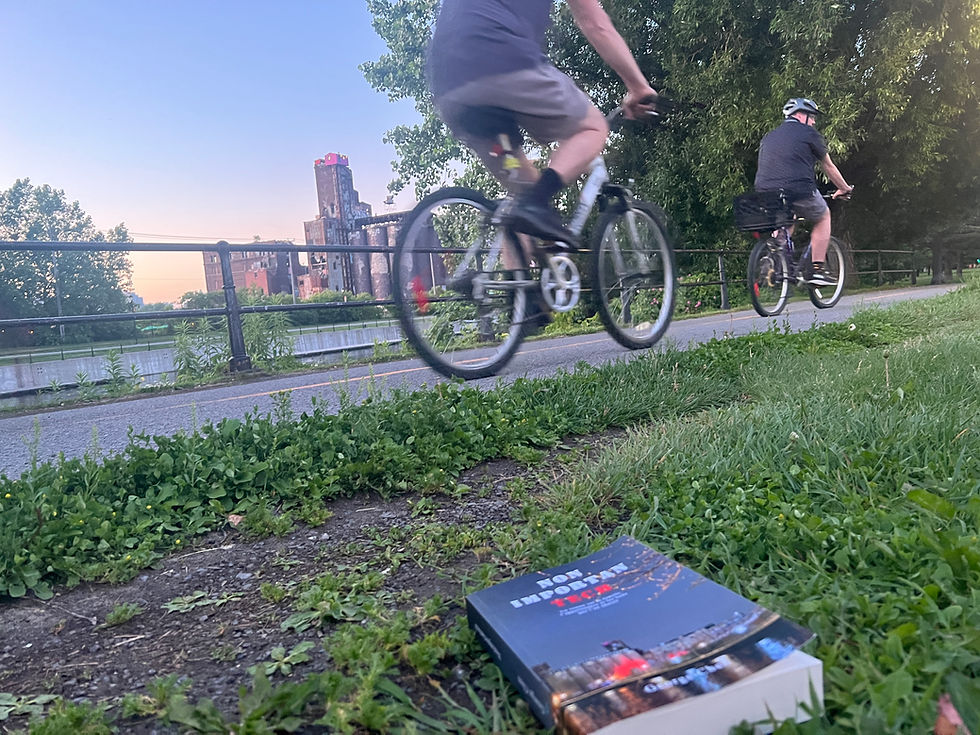
That thought brought me back to one of the characters in my novel Nonimportantech.
Dr. Qi Aiguo comes from a family of caravan guards.
Although he later became a scientist, he never completely lost that older instinct.
When he enters a new building, he notices the beams before the decoration.
He looks at joints, ventilation, materials, and structure before admiring technology.
He still trusts his hands as much as his mind.
In many Western novels, cowboys behave in much the same way.
They read the sky before they read a map.
They understand the land before they understand politics.
They rarely describe themselves as heroes.
They simply do the work that needs to be done.
Perhaps that is why I have never thought of Nonimportantech as a novel about heroes.
It is a novel about ordinary people trying to remain human while building extraordinary technologies.
In a world increasingly shaped by artificial intelligence, satellites, algorithms, and virtual spaces, I sometimes wonder whether our future will still need people who instinctively touch a wall, examine the soil, or pause to smell the rain.
Watching those muddy rodeos in Alberta, I found my answer.
Technology may change.
But the earth beneath our boots still teaches us who we are.


Comments