


When Light Returns to the Screen
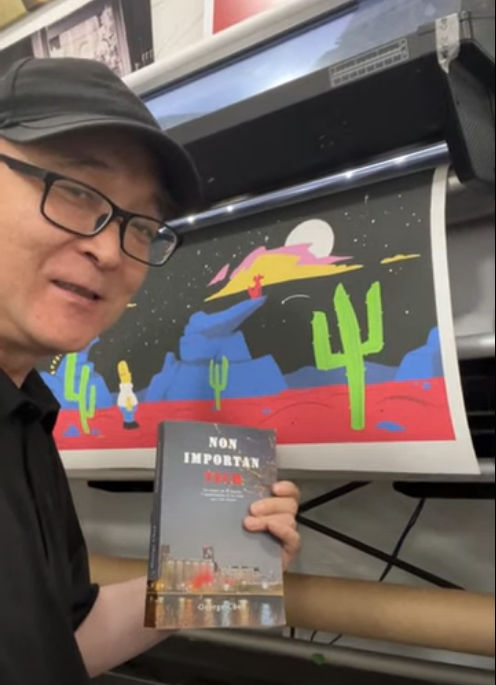
Yesterday, one of my regular customers came into my little print shop with a beautiful 15 × 30-inch panoramic photograph. The landscape was breathtaking. We carefully prepared the file and sent it to the printer.
When the print emerged, he looked at it for a moment before saying,
"The saturation seems weaker than on my screen."
I understood exactly what he meant.
Years ago, people often told us the opposite—that our prints looked too saturated. Curious about color management, I took digital imaging courses at LaSalle College, while my wife Annie completed the Commercial Photography AEC program at Dawson College. Our instructors all repeated the same lesson:
No matter how carefully you calibrate your equipment, a print will never look exactly like a monitor.
Not because the printer is inaccurate.
Because they belong to two different worlds.
A screen creates its own light.
Paper simply reflects the light around it.
Calibration helps both devices speak the same language, but it cannot change the laws of physics.
Then I tried a little experiment.
I photographed the printed panorama with my phone.
When I looked at that photograph on the screen, something surprising happened.
The colors looked remarkably close to the original file again.
The print itself had never changed.
Only the light had returned.
That small moment made me smile.
Every day, we compare paper with glowing screens and wonder why they look different. Yet once paper is photographed and displayed on another screen, we suddenly feel that everything is "correct" again.
Perhaps we are no longer comparing images.
Perhaps we are comparing light itself.
As I was thinking about this, my eyes wandered toward a copy of my novel, Nonimportantech, resting quietly on a shelf in my shop.
People can discover that story on a screen.
They can read it on a Kindle.
Or they can hold the printed book in their hands.
The words remain the same.
Only the medium changes.
And somehow, every medium tells the story differently.
Maybe that is why I still love printing after all these years.
A print is not trying to compete with a screen.
A printed book is not trying to imitate an e-book.
They offer something a screen cannot.
Weight.
Texture.
Silence.
Time.
When we close a laptop, the light disappears instantly.
When we close a book, the story quietly waits.
Perhaps technology will continue to give us brighter screens and more brilliant colors.
But paper still offers something that light alone cannot.
It stays.


Comments